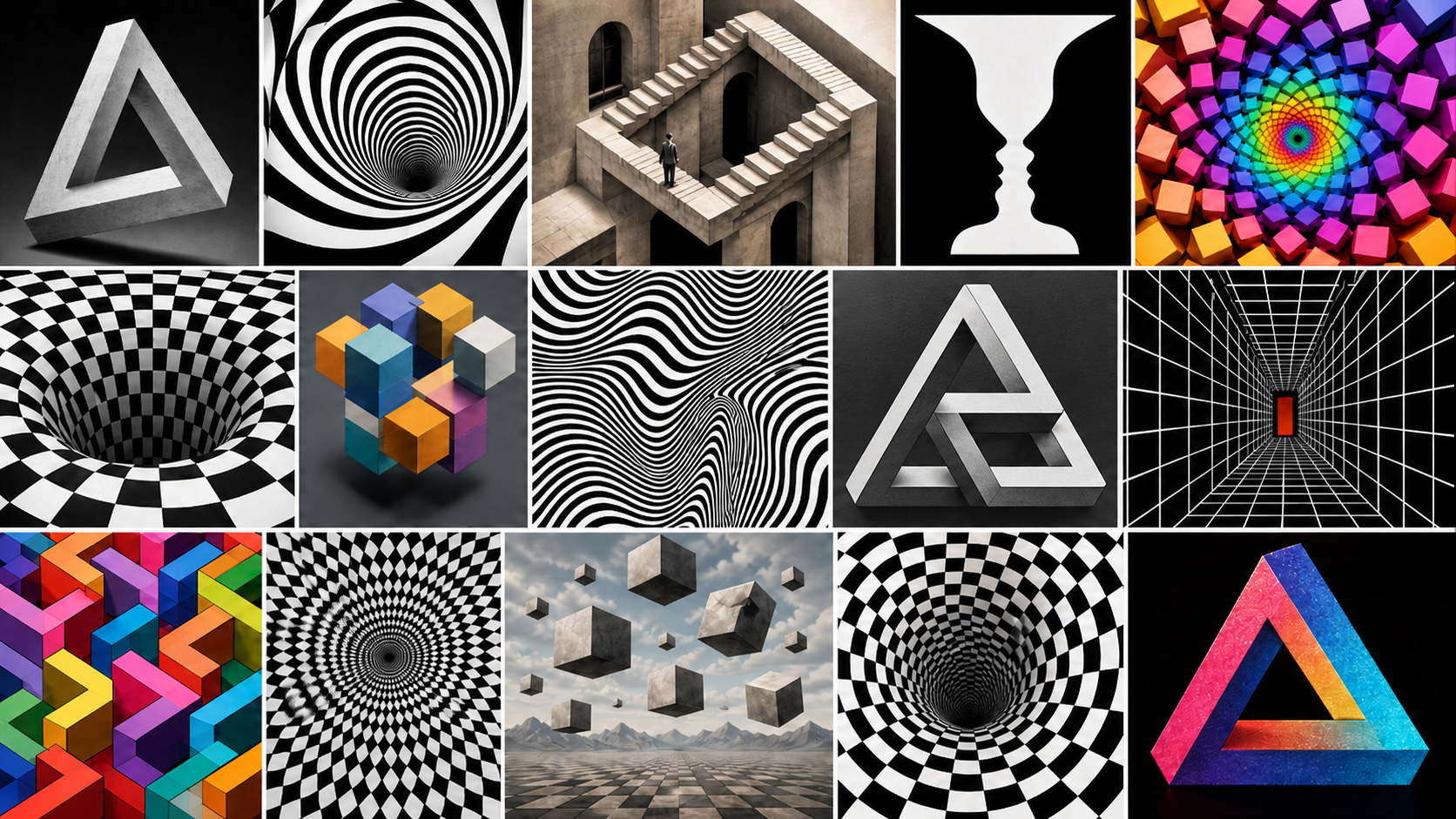
Op Art & Geometric Illusions
Artists who exploit the geometry of pattern, contrast, and color to generate motion, depth, and vibration in static forms.
Pioneer of the Op Art movement. Riley's paintings of repeating geometric forms — stripes, waves, discs — produce vivid perceptions of movement, dazzle, and spatial vibration through pure visual contrast.
View ProfileWidely regarded as the grandfather of Op Art. Vasarely's systematic exploration of color relativity and geometric distortion produced works that pulse, bulge, and recede with autonomous visual energy.
View ProfileProfessor of psychology whose precisely engineered rotating snakes, expanding rings, and drifting lattices are among the most widely circulated motion illusions in modern visual science.
Visit SiteImpossible Structures & Mathematical Art
Works that exploit the rules of perspective, topology, and geometry to construct objects that cannot exist — yet appear entirely coherent at a glance.
The definitive artist of mathematical impossibility. Escher's prints of impossible staircases, tessellating lizards, and self-referential hands remain the canonical image of art and mathematics in dialogue.
Official SiteThe "father of impossible figures," Reutersvärd created the impossible triangle independently of Penrose and went on to produce thousands of impossible objects across a prolific career spanning five decades.
View ProfileInventor of "reverspective" — three-dimensional painted reliefs that appear to invert as the viewer moves, making receding surfaces rush forward in a viscerally disorienting reversal of depth cues.
View ProfileAnamorphic & Street Illusions
Artists who collapse the boundary between painted surface and physical space, creating impossible volumes and three-dimensional worlds from a single, precise vantage point.
Master of pavement anamorphosis. Beever's chalk drawings produce photorealistic illusions of chasms, swimming pools, and architectural extensions that vanish the instant the viewer steps off-axis.
Visit SiteVarini applies geometric paintings — circles, ellipses, grids — across complex architectural surfaces. From a single fixed point, the fragments cohere into a perfect flat shape; from any other angle, they dissolve into apparent chaos.
View ProfileFormer NASA artist turned street painting pioneer. Wenner developed the mathematics of street painting perspective in the 1980s and continues to produce monumental anamorphic works worldwide.
View Profile